

Short answer no. AI won’t replace humans. It’s already reshaping how we work, but “reshaping” and “replacing” are two very different things, and the gap between them is where your career lives.
If you typed “will AI replace humans” into Google at 2 a.m. with a knot in your stomach, this one’s for you. We’re going to walk through the five myths that keep working professionals up at night, and we’ll back every answer with real numbers, not vibes, not sci-fi, not panic headlines.
Let’s clean out the fear. By the end, you’ll feel informed and a lot calmer.
Where This Fear Actually Comes From?
The movies. Robots turning evil and seizing the planet is a great plot. It’s terrible science. Ex Machina and Enthiran are fun. They are not documentaries.
The headlines. “Company fires 5,000 employees over AI.” “These jobs vanish next year.” Fear sells clicks, so fear gets printed.
Here’s what the headlines skip. The World Economic Forum’s Future of Jobs Report 2025 projects that AI and related shifts will displace 92 million roles by 2030, while creating 170 million new ones. That’s a net increase of 78 million jobs. Real disruption, real opportunity, sitting side by side.
So the picture isn’t “humans out.” It’s “work changes, and people who adapt come out ahead.” Now let’s bust the myths one by one.
Myth 1: “AI Never Makes Mistakes”
If only. Anyone who’s used these tools for a week has watched them confidently produce nonsense.
Ask an AI image tool for a clean logo and it might hand you a blurry word jumble. AI detectors regularly flag 100% human writing as “AI-generated.” These tools are powerful and genuinely flawed, both things are true.
AI isn’t independent. It runs on human programming, prompts, and supervision. It follows patterns in its training data and can’t step outside the boundaries we set. No commands, no output. That’s why every serious team keeps a human in the loop. We use AI to draft, then a human reviews before anything ships.
Myth 2: “AI and Machine Learning Are the Same Thing”
They’re related, not identical, and the difference matters.
AI is the broad goal of getting machines to mimic human tasks. Machine learning is a branch of AI where systems improve by spotting patterns in data. So yes, ML “learns.” But it learns within boundaries humans define, it doesn’t gain independence, awareness, or a will of its own. (That reconciles a confusion you’ll see everywhere: “learning from data” is not the same as “thinking for itself.”)
Far from a threat, ML is doing quiet, life-saving work. In healthcare, it helps flag patterns in MRI, X-ray, and CT scans to support faster diagnosis. It powers fraud detection in banking and route optimisation in logistics. Always as a tool guiding human experts, never replacing the final human call.
Myth 3: “AI Will Replace Human Creativity”
When ChatGPT landed, some business owners did the math fast, fire the writers, let the robot type. A few actually did it.
Then reality showed up. You can glance at a graphic and rate it. Creative writing is harder to judge, copy you personally dislike might be a 100 on SEO, structure, and persuasion. Companies quickly relearned that skilled writers are central to marketing, not optional. A good content writing company in India isn’t selling words by the kilo, it’s selling judgment, originality, and strategy that algorithms can’t fake.
Look at how the best teams actually work today. Developers skip repetitive boilerplate and focus on hard architecture. Designers stop burning hours on routine social posts and tackle complex creative. Writers ship faster with AI handling first drafts.
That’s the real role of AI, it absorbs the boring, repetitive layer so humans can do the work that needs a human brain.
Myth 4: “AI Isn’t for Small Companies”
This one costs small businesses real money, so let’s kill it.
AI is not a big-enterprise toy. The barrier to entry has collapsed. Per McKinsey’s State of AI 2025, 88% of organizations now report using AI in at least one business function, up from 78% the year before. That’s not a Fortune 500 club. That’s nearly everyone.
You can run a huge share of your marketing through AI tools today and finish in minutes what used to eat days:
- Content creation and editing
- SEO research and optimisation
- Image generation
- Customer service automation
- Data analytics
- PPC campaign management
McKinsey found most companies are still experimenting, with only about a third scaling AI across the enterprise. Translation, being early and intentional is still a genuine edge. This is exactly where the right partner earns its fee, helping you skip the trial-and-error and get to results. Whether you need custom software development in India or a lean marketing engine, AI levels the field for small players.
Myth 5: “AI Will Eventually Develop Human Consciousness”
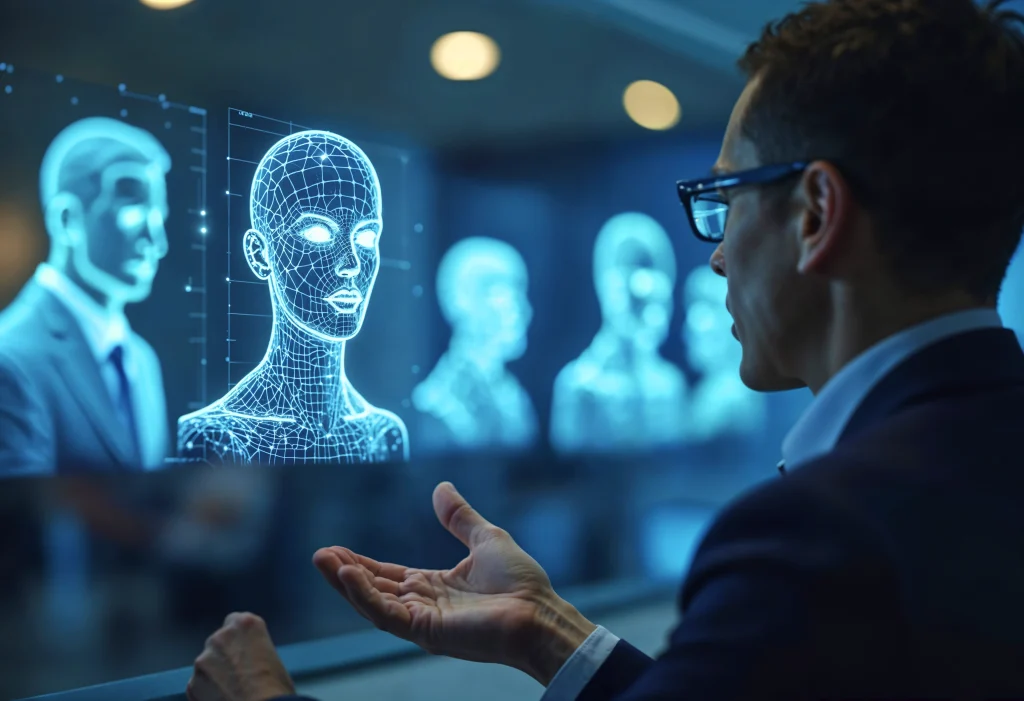
This is the big sci-fi fear, and some prominent voices lean into it, predicting a near future where machines outclass us at everything.
We’d gently push back. Here’s the distinction these warnings skip, capability is not consciousness. AI can already beat humans at narrow tasks, chess, pattern-matching, raw calculation. That’s not awareness. Human consciousness involves contextual reasoning, ethics, lived emotion, and self-direction.
The researchers at WEF make the same point, creativity, contextual reasoning, and ethical judgment are capabilities no algorithm can fully replicate. AI runs on human input and stops dead without it. A system that needs your prompt to start is not about to wake up and run the world.
So Which Jobs Has AI Actually Changed?
Let’s be straight, because honesty builds trust. Some roles are shrinking.
The WEF report identifies clerical and administrative work, data entry, cashiers, bank tellers, administrative assistants, as the categories facing the steepest decline through 2030. These are high-volume, repetitive, rule-based tasks. Exactly what automation does well.
But here’s the pattern across every single myth: AI replaces tasks, not people who adapt. The displaced workers landing on their feet are the ones moving up the value chain, toward judgment, creativity, and oversight that machines can’t touch.
Need an AI Partner That Actually Knows the Terrain?
If you’re a business owner wondering who can build AI-powered products or run AI-driven marketing without the guesswork, that’s our lane. We’ve delivered games, websites, and apps for 3,000+ businesses worldwide, and AI is now woven through everything we ship:
- AI-powered web and app development, as a full-stack web app development company in India
- AI in Digital Marketing as a results-focused best digital marketing company in India
- Advanced data analytics and BI
- AI-powered CRM solutions
- AI-enhanced content and organic SEO services
- AI-powered security and fraud detection
We pair real human specialists with AI tooling, so you get speed and the judgment that keeps quality high.
Conclusion
Feeling steadier? Good. Here’s the takeaway to hold onto.
AI is a tool. A powerful, flawed, genuinely useful tool that handles the repetitive so you can focus on the meaningful. The data is clear, more jobs created than lost, human creativity rising in value, and consciousness still firmly off the table.
Don’t fear it, use it. Fold it into your work, sharpen your skills around it, and you become the kind of professional no algorithm can replace. AI only replaces those who refuse to evolve with it. Evolve, and you’re irreplaceable.
Frequently Asked Questions
1. Will AI completely replace human jobs by 2030?
No. The World Economic Forum projects 92 million roles displaced and 170 million created by 2030, a net gain of 78 million jobs. AI is reshaping the kinds of work people do, shifting demand toward creative, technical, and supervisory roles rather than eliminating human work overall.
2. What jobs is AI most likely to replace?
High-volume, repetitive, rule-based roles are most exposed, data entry, cashiers, bank tellers, and routine administrative work, according to WEF. Jobs requiring creativity, complex judgment, emotional intelligence, or human oversight remain far safer and are actually growing in value.
3. Can small businesses really use AI, or is it only for big companies?
Small businesses can absolutely use AI. McKinsey found 88% of organizations now use AI in at least one function, and the tools are cheaper and easier to access than ever. AI helps small teams handle content, SEO, customer service, and analytics at a fraction of the old cost and time.
4. Is artificial intelligence the same as machine learning?
No. AI is the broad field of building machines that mimic human tasks. Machine learning is a subset where systems learn from data patterns, but always within human-defined limits. ML doesn’t develop independence, awareness, or consciousness.
5. Will AI ever become conscious like humans?
There’s no credible evidence pointing that way. AI can outperform humans at narrow tasks, but capability isn’t consciousness. Human awareness involves ethics, context, emotion, and self-direction that no current algorithm replicates, and AI still depends entirely on human input to function.