

India processed over 7.3 million international patients in 2024, a figure that nearly rivals the entire population of Switzerland seeking treatment in a single country. Yet this remarkable growth masks a critical problem, the medical tourism industry still operates with 20th-century inefficiencies.
An international patient from London needs spine surgery in Bangalore. What should be a straightforward process becomes a coordination nightmare. They search for surgeons online, exchange dozens of emails, mail medical records via courier (some get lost), struggle with appointment scheduling across time zones, worry about medical record privacy, struggle with visa coordination, and then finally, after weeks of uncertainty, book a flight. Technology is removing these friction points.
This guide explores how medical tourism technology solutions are reshaping how international patients access Indian healthcare. Whether you’re a patient seeking treatment, a hospital administrator seeking growth, or a healthcare entrepreneur building solutions, this article breaks down the actual impact of technology on medical tourism, with honest assessment of what works, what doesn’t, and how to implement these tools successfully.
Medical Tourism in India. The Current Landscape & Opportunity
Why India Dominates Medical Tourism
India attracts more international patients than any other destination in South Asia, and for good reason:
Clinical excellence: Indian surgeons perform over 15 million surgeries annually, with success rates matching or exceeding US hospitals. Joint replacements, cardiac surgeries, spine procedures, and complex cancers are handled routinely.
Cost advantage: A knee replacement costs $30,000-40,000 in the US. In India’s top hospitals, the same procedure with equivalent expertise costs $12,000-16,000, a 60-70% reduction.
Accessibility: Joint Commission International (JCI)-accredited hospitals meet global standards, yet remain geographically accessible (major centers in Delhi, Bangalore, Mumbai, Chennai).
Alternative medicine: Ayurveda, Naturopathy, and Yoga are integrated into treatment plans, unique values unavailable in Western medicine.
The Growth Numbers (2019-2026)
- 2019: 7 million international patients
- 2020-2021: Dropped to 2-3 million (COVID impact)
- 2024: Rebounded to 7.3 million
- 2025-2026 projection: 9-12 million (with tech adoption)
The Hidden Challenge Nobody Talks About
Despite India’s clinical superiority and cost advantage, the patient experience lags behind Western medical tourism destinations. Why?
- Information asymmetry: Patients don’t know which hospital is actually best for their specific condition
- Fragmentation: No unified platform connecting patients, doctors, hospitals, visa agents, and accommodations
- Trust deficit: Language barriers, cultural unfamiliarity, and scam risks deter cautious patients
- Operational inefficiency: Hospitals use manual processes for appointment scheduling, record management, and treatment coordination
- Documentation chaos: Medical records scattered across clinics, hospitals, and couriers
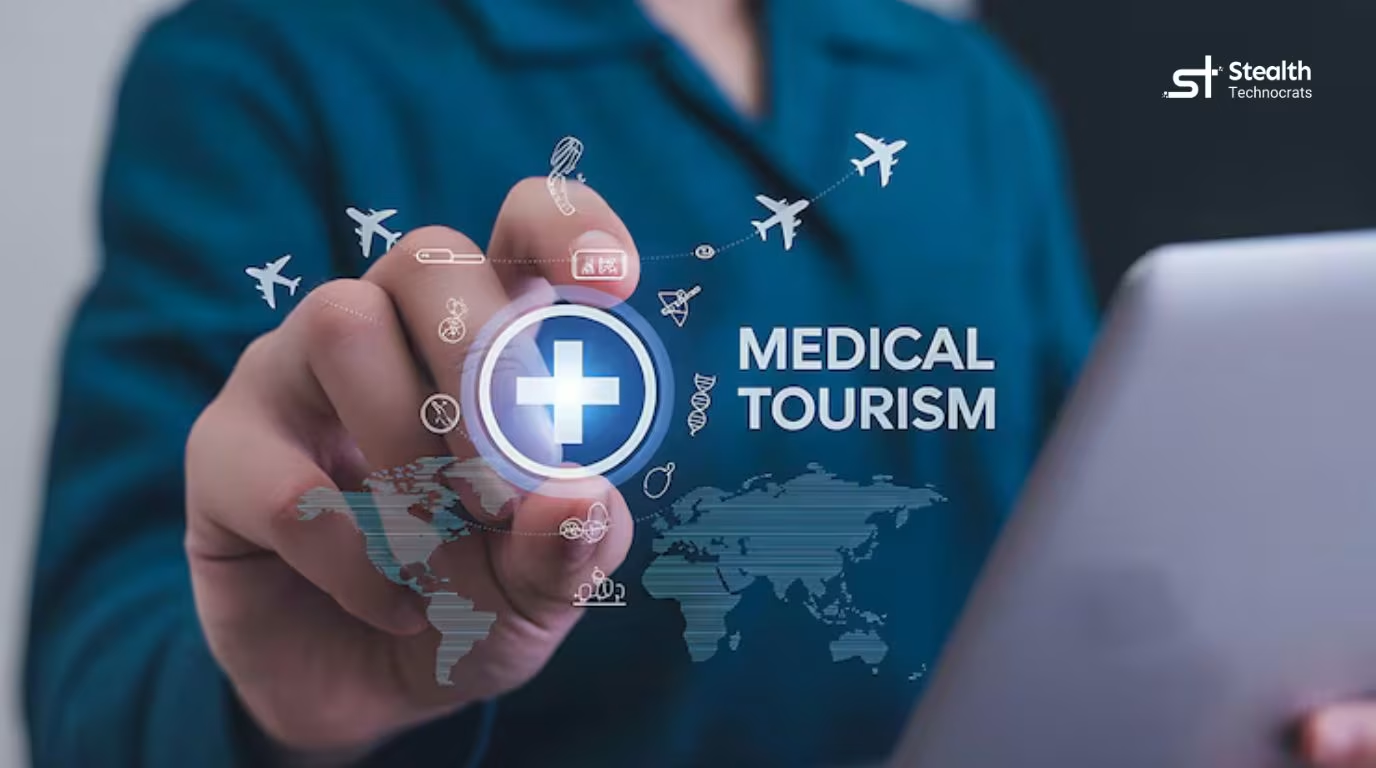
The Core Problems Technology Must Solve
Before examining specific technologies, let’s define the actual problems they address:
Problem 1: The Discovery & Trust Gap
Patient pain point: How do I find a trustworthy surgeon I can communicate with before committing $20,000?
Without Tech: Research website ratings, exchange vague emails, make a leap of faith.
With Tech: Screen multiple surgeons via video, review verified credentials, read transparent case outcomes, confirm expertise in your specific condition.
Problem 2: The Medical Record Crisis
Patient pain point: I have scan reports in three different hospitals. How do I ensure my Indian doctor has complete information?
Without Tech: Phone calls, courier services, incomplete information, repeated tests ($5,000+ wasted).
With Tech: Cloud-based system where all records live in one place, accessible to any authorized doctor, patient, or hospital.
Problem 3: The Coordination Nightmare
Patient pain point: I need a visa, hotel near the hospital, appointment with the surgeon, and follow-up care. Who coordinates all this?
Without Tech: Dozens of phone calls, confusing timelines, missed appointments, last-minute scrambles.
With Tech: Single platform where visa status, hotel booking, appointment, and transport are all connected.
Key Technologies Transforming Medical Tourism
1. Virtual Consultation Platforms (MedyXO)
What It Is
A virtual consultation platform is a HIPAA-compliant video conferencing system designed specifically for healthcare. Unlike Zoom (which is consumer-grade), medical telemedicine platforms include medical record access, prescription management, payment processing, and appointment scheduling in one ecosystem.
The Problem It Solves
International patients currently lose 2-6 weeks and $2,000-5,000 just traveling to initial consultations. Virtual consultations compress this into 24 hours and under $200.
2. Electronic Health Records (EHR Systems)
What It Is
An Electronic Health Record (EHR) system is a cloud-based platform that stores all patient medical data, diagnostic reports, lab results, prescriptions, treatment plans, allergies, medication history, and imaging, in one secure location, accessible by authorized healthcare providers.
Why EHRs Are Critical for Medical Tourism
International patients often see multiple doctors across different hospitals:
- Initial consultation: Bangalore clinic
- Imaging review: Mumbai hospital
- Surgery: Different facility
- Follow-up: Back home with local doctor
Without EHRs, each facility has fragmented records. With EHRs, one complete medical record follows the patient everywhere.
How EHRs Solve The Medical Record Crisis
Without EHR:
- Patient scans MRI in New York → emails DICOM files → surgeon in Bangalore can’t open them properly → orders repeat MRI → $3,000 wasted
- Treatment notes buried in different hospital systems → follow-up surgeon doesn’t see medication allergies → dangerous drug interaction → hospital liability
With EHR:
- Patient uploads MRI once → immediately accessible to all authorized doctors → no repeat scans → $3,000 saved
- Complete medication history visible to every clinician → drug interactions flagged automatically → patient safety improved
3. AI-Powered Patient Diagnosis & Doctor Matching
What It Is
AI diagnosis technology uses machine learning models trained on millions of medical cases to:
- Analyze patient symptoms/reports
- Predict likely diagnoses
- Recommend appropriate specialists
- Flag urgent vs. routine conditions
Important Reality Check: AI ≠ Doctor Replacement
The 2024 hype around AI replacing doctors is misleading. In medical tourism, AI’s real value is different:
Where AI Works (High Accuracy):
- Dermatology (skin condition diagnosis): 92-95% accuracy (competing with dermatologists)
- Diabetic retinopathy screening: 94-97% accuracy
- Chest X-ray interpretation: 88-92% accuracy
- ECG abnormality detection: 91-94% accuracy
Where AI Struggles (Lower Accuracy):
- Complex multi-system diagnosis: 65-75% accuracy
- Rare diseases: 40-60% accuracy (not enough training data)
- Surgical planning: 50-70% accuracy (requires surgeon’s experience)
- Treatment recommendations: 60-75% accuracy (highly patient-specific)
The Honest Assessment of AI in Medical Tourism
What AI Actually Does Well:
- ✓ Speeds up initial symptom evaluation (3 minutes vs. 20 minutes with receptionist)
- ✓ Reduces unnecessary consultations (correctly identifies when patient doesn’t need specialist)
- ✓ Enhances doctor’s decision-making (second opinion system, not replacement)
- ✓ Improves documentation (summarizes patient symptoms for chart)
What AI Cannot Do:
- ✗ Replace nuanced clinical judgment (requires years of experience)
- ✗ Diagnose rare or complex conditions reliably
- ✗ Make treatment recommendations for patient-specific factors
- ✗ Handle emergencies (humans still required)
4. Medical Tourism Management Software (All-in-One Platforms)
What It Is
Medical tourism software is an integrated platform that handles the entire patient journey:
- Doctor/hospital search
- Appointment scheduling
- Medical record management
- Visa coordination
- Hotel booking
- Ground transportation
- Payment processing
- Post-operative follow-up
Think of it as Airbnb for medical tourism, one platform, complete journey.
Why All-in-One Platforms Matter
An international patient’s medical tourism journey involves 6-8 different entities:
- Airlines (flights)
- Hotels (accommodation)
- Visa agency (paperwork)
- Hospital (surgery)
- Pharmacy (medications)
- Ground transport (taxis/drivers)
- Insurance company (coverage)
- Follow-up clinic (aftercare)
Without software: Patient coordinates with all 8 separately. Timeline: 8-12 weeks, stress level: extreme.
With software: One platform connects all services. Timeline: 2-3 weeks, stress level: manageable.
Most hospitals use a hybrid, their own telemedicine + third-party medical tourism platform.
5. Digital Payment Systems & Insurance Integration
What It Is
Digital payment systems enable international patients to pay for medical services securely and transparently, with automatic insurance coordination.
Why This Matters for Medical Tourism
Problem: International patient from Australia owes hospital $15,200.
- How do they pay? Wire transfer? Credit card? Cryptocurrency?
- What if insurance covers $14,500? Who handles that pre-authorization?
- What currency? USD? INR? Exchange rate risk?
- Is it secure? Will hospital data be breached?
Solution: Integrated payment platform that handles:
- Multi-currency payment (INR, USD, GBP, AUD)
- Insurance pre-authorization (hospital doesn’t get paid until insurance approves)
- Payment plans (pay 50% upfront, 50% post-discharge)
- Secure PCI-DSS compliance (no credit card hacking)
- Automated reconciliation (clear accounting trail)
Insurance Pre-authorization (Critical for International Patients)
Many international patients have health insurance that covers medical tourism (especially from US, UK, Australia).
Without integration:
- Patient sends insurance claim manually
- Insurer takes 6-8 weeks to review
- Insurance approves $14,500; hospital demands full $15,200 upfront
- Conflict, delayed surgery
With integration:
- Hospital platform submits to insurer digitally
- Insurer approves within 48 hours
- Hospital receives payment directly
- Patient only pays co-pay ($700)
Compliance & Security (Non-Negotiable)
PCI-DSS Compliance (Payment Card Industry):
- Credit card data must be encrypted end-to-end
- Access logged and monitored
- Regular security audits
- Breach notification within 72 hours
Data localization (India):
- Medical data must reside on Indian servers
- Patient consent required for data export
- Breach notification to RBI within 72 hours
Most platforms: Outsource to specialized payment providers (Razorpay, PhonePe, Instamojo) rather than build in-house.
Emerging Technologies: What’s Next for Medical Tourism
Blockchain for Medical Records
Potential: Patients own their medical records via blockchain wallet. Share with any doctor instantly. No more record loss.
Reality (2026): Interesting concept, not yet viable at scale. Only 2-3 hospitals experimenting globally.
Timeline: 3-5 years before practical adoption.
Extended Reality (AR/VR) for Consultations
Potential: Patient in London. Surgeon in Bangalore uses VR to examine patient remotely as if in-person. Guides patient through pre-operative exercises in augmented reality.
Reality (2026): Proof of concepts exist. Too expensive for routine use ($100K+ per setup). Works for complex cases.
Timeline: 2-3 years before mainstream adoption.
Predictive Analytics for Patient Outcomes
Potential: AI predicts surgery success rate for individual patient based on their profile. Alerts doctors to high-risk patients. Enables personalized treatment plans.
Reality (2026): Working well for high-volume surgeries (knee replacement, cataract). Developing for complex surgeries (cancer, cardiac).
Timeline: 1-2 years before widespread adoption.
Telemedicine + AI + Robotics
Potential: Surgeon in Bangalore performs robotic surgery on patient in London with real-time teleoperation. AI assists with precise movements.
Reality (2026): Technically possible but extremely expensive ($5M+ per setup). Regulatory barriers (liability, licensing). Only in cutting-edge centers.
Timeline: 5-10 years before routine use.
Key Takeaways
- Medical tourism is growing — India processed 7.3 million international patients in 2024, with 9-12 million projected by 2026.
- Technology solves real problems — Virtual consultations reduce patient travel time by 90%. EHRs reduce repeat testing by 50%. Smart platforms compress coordination from 8-12 weeks to 2-3 weeks.
- AI is useful but not magic — AI works well for initial symptom screening and doctor recommendations. It doesn’t replace clinical judgment.
- EHRs are essential for safety — Fragmented medical records cause errors. Cloud-based EHRs are non-negotiable for international patients.
- Integration is harder than adoption — Choosing technology is 20% of the work. Making systems talk to each other is 80%.
- Compliance is existential — Data privacy violations result in massive fines ($1M-50M+) and destroyed trust.
- ROI comes quickly — If implemented well, hospitals see positive ROI within 4-6 months and 30-50% efficiency gains within 12 months.
- Phased implementation works — Don’t try to do everything at once. Start with telemedicine, add EHR, then expand.
- Staff training is critical — The best technology fails if staff don’t know how to use it.
- Patient experience is the metric that matters — Choose technologies based on what reduces patient friction, not what looks impressive.
The Future of Medical Tourism is Now
In 2019, medical tourism in India felt risky and complicated for international patients. In 2026, technology has transformed the experience into something remarkably smooth.
The question for hospitals isn’t Should we adopt technology? It’s How quickly can we implement it before our competitors do?
The hospitals implementing telemedicine + EHRs + smart platforms today will capture the next wave of international patients. Those waiting will become commoditized.
Your Next Step
If you’re a hospital or clinic administrator considering technology adoption:
- Identify your biggest pain point (where do patients struggle most?)
- Talk to 3-5 vendors (get real pricing, timelines, case studies)
- Start small (telemedicine often has the fastest ROI)
- Measure relentlessly (what gets measured gets improved)
The future of medical tourism isn’t just about surgical excellence anymore. It’s about patient experience. And that’s where technology makes all the difference.
FAQ Section
1: Which technology is most important for starting a medical tourism business?
Virtual consultation platforms and Electronic Health Record (EHR) systems are the most important technologies for launching a medical tourism business. They help doctors assess international patients remotely, securely manage medical records, and streamline treatment planning before patients travel.
Virtual consultations build trust and reduce unnecessary travel, while EHR systems allow healthcare teams to access patient history, lab reports, and treatment records from anywhere. These two technologies create the foundation for a smooth patient journey.
2: How much can medical tourism technology save international patients?
Medical tourism technology can reduce overall costs by 15% to 35%, depending on the treatment and patient location.
Savings come from virtual consultations, automated scheduling, digital document management, and faster treatment planning. Patients also spend less on travel, accommodation, and repeated diagnostic tests because much of the process is completed before arriving at the destination.
3: What’s the difference between EHR and telemedicine platforms for medical tourism?
An EHR system stores patient medical records, while a telemedicine platform enables online consultations between doctors and patients.
Both technologies serve different purposes but work together. During a virtual consultation, doctors use the patient’s electronic health records to review medical history, test reports, and previous treatments, allowing for more informed clinical decisions.
4: Is AI diagnosis technology reliable for medical tourism initial consultations?
Yes, AI diagnosis tools are reliable for initial screening, but they should support, not replace, medical professionals.
AI helps analyze symptoms, recommend specialists, and prioritize urgent cases. However, final diagnoses and treatment decisions should always be made by qualified healthcare providers after reviewing the patient’s complete medical history.
5: How long does it take for a clinic to implement medical tourism technology?
Most clinics can implement medical tourism technology within 3 to 6 months, while larger healthcare organizations may require up to 12 months.
The timeline depends on the number of systems being integrated, staff training, regulatory compliance, and existing digital infrastructure. A phased implementation approach helps ensure a smooth transition with minimal disruption.